Blog
Guides
Will AI Recommend Your Brand? A CMO’s Guide to Making the Shortlist
Get your brand onto AI shortlists. Explore how CMOs can connect consumer insights, content and credible evidence in a practical 90-day GEO strategy.

Matthieu Danielou
Co-founder & CEO

Your next customer could explain exactly what they need, compare their options and build a shortlist before ever visiting your website.
AI search introduces a new intermediary into that journey: an assistant that interprets the consumer’s circumstances and helps them decide which brands deserve consideration.
For marketers, this raises a pressing question: when someone describes a problem your product solves, will your brand be part of the answer?
Generative Engine Optimization, or GEO, is the emerging discipline focused on improving how brands appear in AI-generated responses. But turning experiments into a sustainable strategy takes more than tweaking website copy.
It requires connecting what your organization knows about consumers with what it publishes about its products, and the evidence others can find to support those claims.
That makes AI search a leadership challenge as much as a content challenge.
1. Understand the buying situation behind the search

Consider the difference between these two searches:
“Best washing machine.”
“I need a washing machine for a family of four, in a small apartment, for under €600. My biggest priority is keeping the noise down.”
The second request gives a brand much more to work with: household size, space constraints, budget and a decisive purchase criterion.
Consumers have always brought this context to conversations with knowledgeable salespeople. Conversational search gives them another place to express it. Google describes AI Mode as supporting nuanced questions that previously might have required several searches. Google’s introduction to AI Mode.
For marketers, the implication is practical. Product information needs to explain which circumstances an offer suits, and why.
“Designed for modern living” tells a buyer very little. Dimensions, capacity, documented noise levels and installation requirements help them assess whether a washing machine fits their home.
The opportunity is to connect product facts to real buying situations.
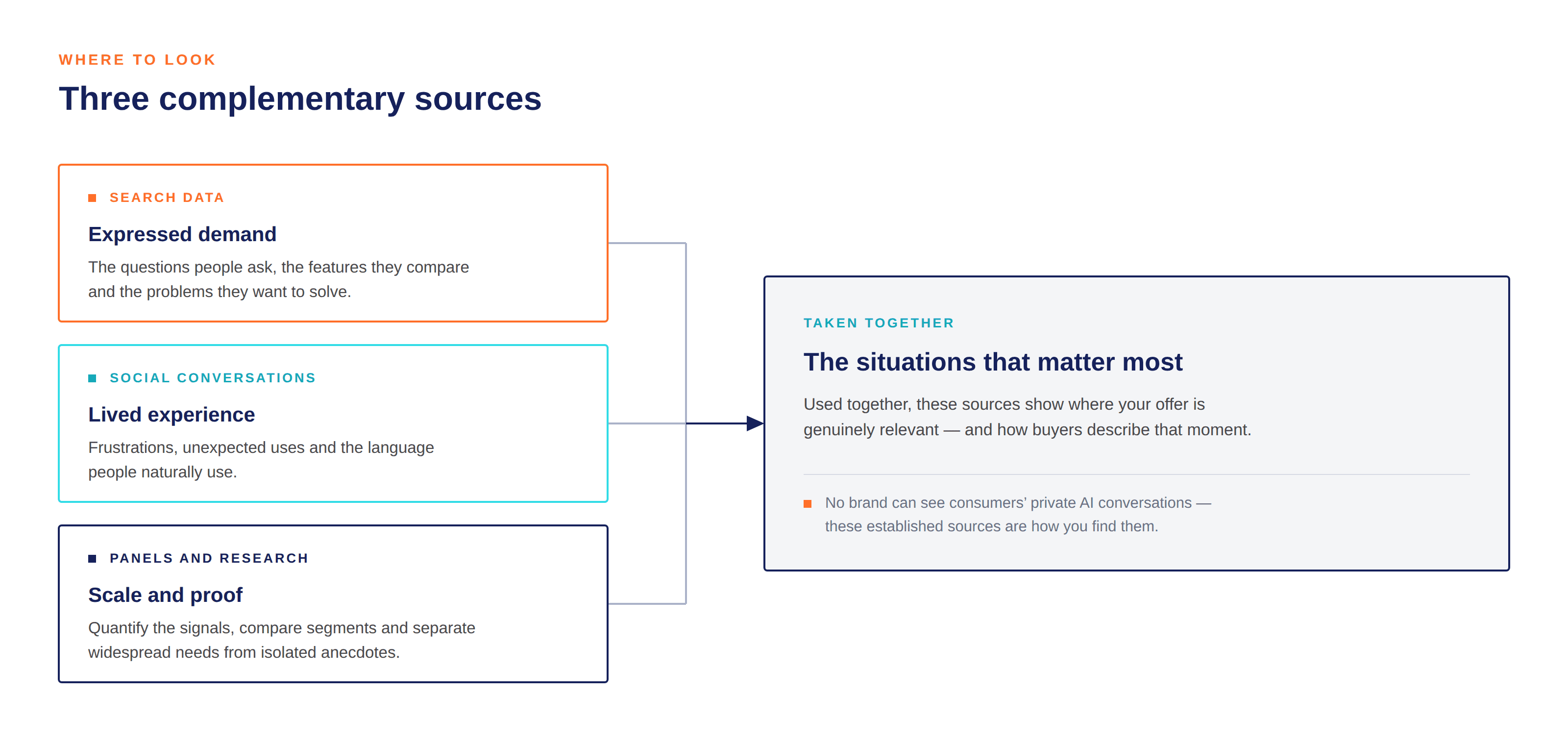
Start by combining three complementary sources of consumer understanding:
Search data reveals expressed demand: the questions people ask, the features they compare and the problems they want to solve.
Social conversations reveal lived experience: frustrations, unexpected uses and the language people naturally use.
Panels and research help quantify those signals, compare segments and distinguish widespread needs from isolated anecdotes.
Brands should not assume they can see consumers’ private AI conversations. They can, however, use these established sources to identify the situations that matter most.
For each priority situation, define the need, the barrier to purchase and the evidence that would make your product a credible choice. That gives content teams a much stronger brief than “create something about our category.”
2. Build the evidence behind the recommendation

In traditional search, brands compete for visibility among links. In an AI-generated answer, another layer selects information, combines sources and describes the available options.
That broadens the objective. A brand needs to be discoverable, represented accurately and considered relevant to the buyer’s circumstances.
SEO remains part of this work. Google explicitly says its established SEO practices remain relevant to AI Overviews and AI Mode. Helpful content, accessible pages and accurate product information still matter.
For marketing leaders, the next step is to examine the information surrounding the brand across channels. Do retailer listings match the product catalog? Are important benefits supported by evidence? Do buying guides answer the questions customers actually ask? Where do independent reviews confirm, or challenge, the brand’s claims?
A useful analogy is Red Bull Media House, whose publishing and distribution activities span sport, culture and lifestyle. It illustrates how a brand can build an editorial presence around its audience’s interests. It is an example of sustained publishing, rather than proof of a particular GEO outcome.
The relevant ambition is to become a useful reference on the subjects your customers care about.
That requires two connected activities.
First, identify the gaps. Combine consumer insights, product knowledge and observations of AI answers. Look for buying situations where your brand is absent, benefits that are misunderstood and claims that lack accessible support.
Then, act across channels. Improve product pages, answer important comparison questions, correct inconsistent retailer information and give relevant journalists, experts and creators access to substantiated facts.
For the washing-machine example, that could mean publishing measured noise levels with their test conditions, explaining capacity requirements and ensuring retailers carry the same dimensions and specifications.
These actions cannot guarantee a recommendation. They can make the offer easier to evaluate and reduce ambiguity about who it serves.
Every important benefit should have evidence behind it, and a clear place where that evidence can be found.
3. Make GEO a shared marketing responsibility

The information needed for this work rarely belongs to one team.
Consumer insights may sit with research. Product specifications may belong to e-commerce or product teams. Brand owns positioning. PR manages media relationships. SEO understands discoverability. Sales and customer service hear the objections that influence purchases.
The CMO can give those teams a shared objective: make the brand a credible choice in a defined set of buying situations.
That starts with clear decisions. Which situations matter most commercially? What supports the brand’s suitability? Where is information missing or inconsistent? Who owns each correction, and its ongoing maintenance?
A shared technology foundation can help teams bring together signals, prioritize work and access approved information. Its value depends on the quality of its inputs: current product data, brand guidelines, documented evidence and relevant customer insights.
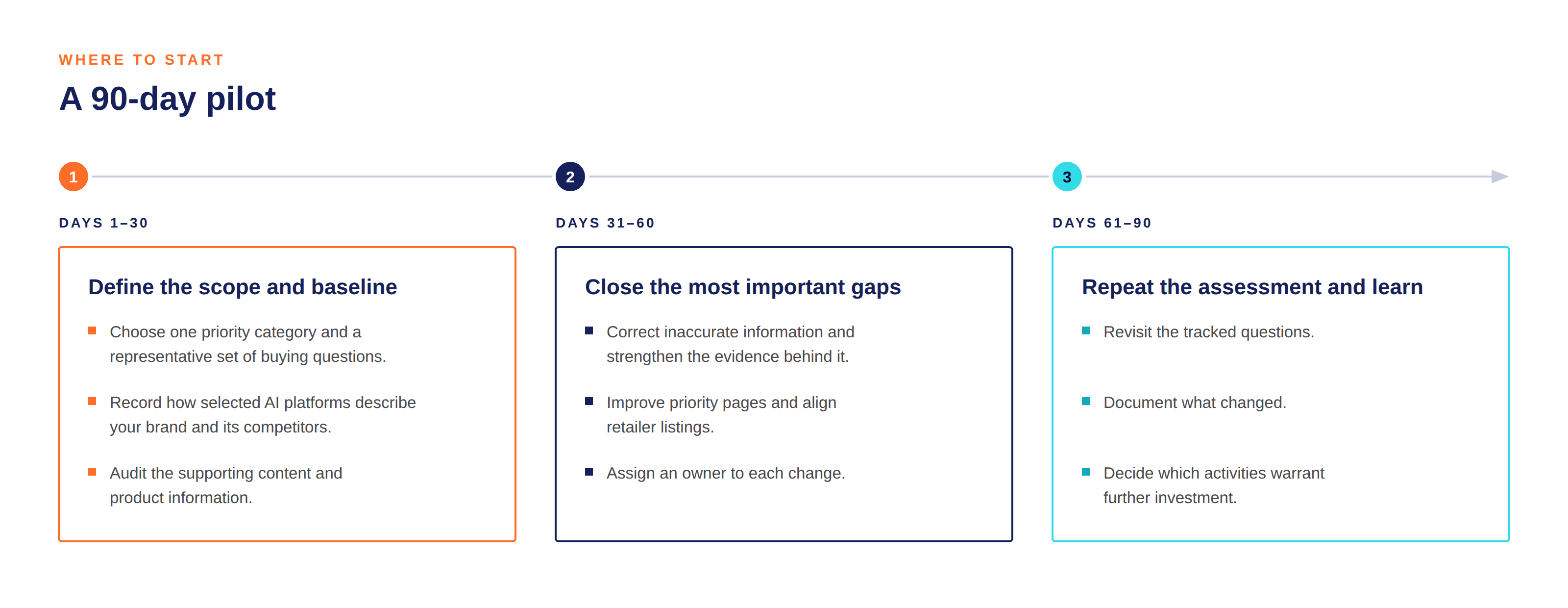
The first milestone should be a working process with clear ownership. A focused 90-day pilot provides a manageable way to establish it:
Days 1–30: Define the scope and baseline. Choose one priority category and a representative set of buying questions. Record how selected AI platforms describe your brand and its competitors. Audit the supporting content and product information.
Days 31–60: Close the most important gaps. Correct inaccurate information, strengthen evidence, improve priority pages and align retailer listings. Assign an owner to each change.
Days 61–90: Repeat the assessment and learn. Revisit the tracked questions, document changes and decide which activities warrant further investment.
Measurement should distinguish being mentioned from being recommended. Track whether the brand appears, whether its description is accurate, which benefits are repeated and whether it is recommended for suitable needs.
Keep the comparison conditions as consistent as possible and record the platform, date and prompt. AI responses can vary, so repeated observations are more useful than a single screenshot.
Then assess those findings alongside traffic, consideration and conversions. More mentions alone do not establish a commercial return.
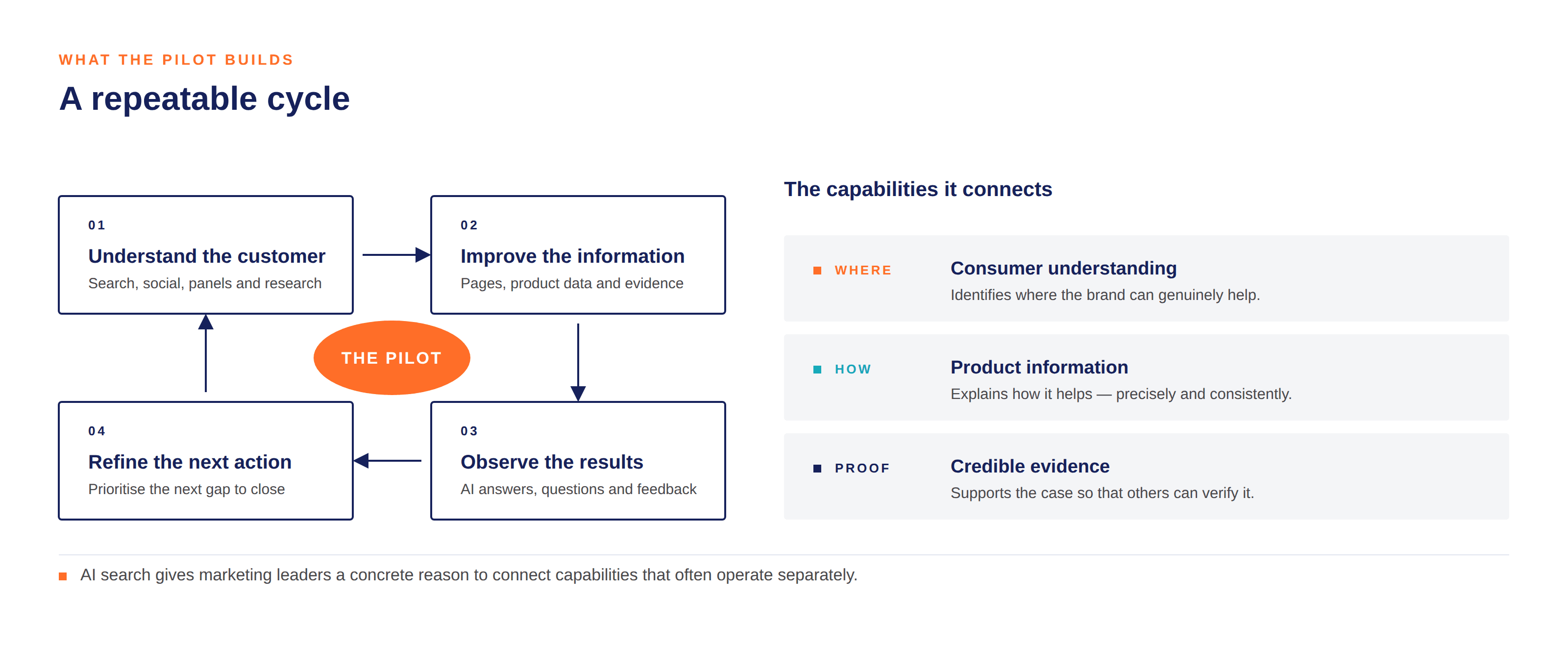
The pilot’s purpose is to create a repeatable cycle: understand the customer, improve the information, observe the results and refine the next action.
AI search gives marketing leaders a concrete reason to connect capabilities that often operate separately. Consumer understanding identifies where the brand can help. Product information explains how. Credible evidence supports the case.
Start with one category, a shared team and 90 days of focused work.
When a buyer explains what matters to them, your brand should have a clear, well-supported reason to make the shortlist.
Your next customer could explain exactly what they need, compare their options and build a shortlist before ever visiting your website.
AI search introduces a new intermediary into that journey: an assistant that interprets the consumer’s circumstances and helps them decide which brands deserve consideration.
For marketers, this raises a pressing question: when someone describes a problem your product solves, will your brand be part of the answer?
Generative Engine Optimization, or GEO, is the emerging discipline focused on improving how brands appear in AI-generated responses. But turning experiments into a sustainable strategy takes more than tweaking website copy.
It requires connecting what your organization knows about consumers with what it publishes about its products, and the evidence others can find to support those claims.
That makes AI search a leadership challenge as much as a content challenge.
1. Understand the buying situation behind the search
Consider the difference between these two searches:
“Best washing machine.”
“I need a washing machine for a family of four, in a small apartment, for under €600. My biggest priority is keeping the noise down.”
The second request gives a brand much more to work with: household size, space constraints, budget and a decisive purchase criterion.
Consumers have always brought this context to conversations with knowledgeable salespeople. Conversational search gives them another place to express it. Google describes AI Mode as supporting nuanced questions that previously might have required several searches. Google’s introduction to AI Mode.
For marketers, the implication is practical. Product information needs to explain which circumstances an offer suits, and why.
“Designed for modern living” tells a buyer very little. Dimensions, capacity, documented noise levels and installation requirements help them assess whether a washing machine fits their home.
The opportunity is to connect product facts to real buying situations.
Start by combining three complementary sources of consumer understanding:
Search data reveals expressed demand: the questions people ask, the features they compare and the problems they want to solve.
Social conversations reveal lived experience: frustrations, unexpected uses and the language people naturally use.
Panels and research help quantify those signals, compare segments and distinguish widespread needs from isolated anecdotes.
Brands should not assume they can see consumers’ private AI conversations. They can, however, use these established sources to identify the situations that matter most.
For each priority situation, define the need, the barrier to purchase and the evidence that would make your product a credible choice. That gives content teams a much stronger brief than “create something about our category.”
2. Build the evidence behind the recommendation
In traditional search, brands compete for visibility among links. In an AI-generated answer, another layer selects information, combines sources and describes the available options.
That broadens the objective. A brand needs to be discoverable, represented accurately and considered relevant to the buyer’s circumstances.
SEO remains part of this work. Google explicitly says its established SEO practices remain relevant to AI Overviews and AI Mode. Helpful content, accessible pages and accurate product information still matter.
For marketing leaders, the next step is to examine the information surrounding the brand across channels. Do retailer listings match the product catalog? Are important benefits supported by evidence? Do buying guides answer the questions customers actually ask? Where do independent reviews confirm, or challenge, the brand’s claims?
A useful analogy is Red Bull Media House, whose publishing and distribution activities span sport, culture and lifestyle. It illustrates how a brand can build an editorial presence around its audience’s interests. It is an example of sustained publishing, rather than proof of a particular GEO outcome.
The relevant ambition is to become a useful reference on the subjects your customers care about.
That requires two connected activities.
First, identify the gaps. Combine consumer insights, product knowledge and observations of AI answers. Look for buying situations where your brand is absent, benefits that are misunderstood and claims that lack accessible support.
Then, act across channels. Improve product pages, answer important comparison questions, correct inconsistent retailer information and give relevant journalists, experts and creators access to substantiated facts.
For the washing-machine example, that could mean publishing measured noise levels with their test conditions, explaining capacity requirements and ensuring retailers carry the same dimensions and specifications.
These actions cannot guarantee a recommendation. They can make the offer easier to evaluate and reduce ambiguity about who it serves.
Every important benefit should have evidence behind it, and a clear place where that evidence can be found.
3. Make GEO a shared marketing responsibility
The information needed for this work rarely belongs to one team.
Consumer insights may sit with research. Product specifications may belong to e-commerce or product teams. Brand owns positioning. PR manages media relationships. SEO understands discoverability. Sales and customer service hear the objections that influence purchases.
The CMO can give those teams a shared objective: make the brand a credible choice in a defined set of buying situations.
That starts with clear decisions. Which situations matter most commercially? What supports the brand’s suitability? Where is information missing or inconsistent? Who owns each correction, and its ongoing maintenance?
A shared technology foundation can help teams bring together signals, prioritize work and access approved information. Its value depends on the quality of its inputs: current product data, brand guidelines, documented evidence and relevant customer insights.
The first milestone should be a working process with clear ownership. A focused 90-day pilot provides a manageable way to establish it:
Days 1–30: Define the scope and baseline. Choose one priority category and a representative set of buying questions. Record how selected AI platforms describe your brand and its competitors. Audit the supporting content and product information.
Days 31–60: Close the most important gaps. Correct inaccurate information, strengthen evidence, improve priority pages and align retailer listings. Assign an owner to each change.
Days 61–90: Repeat the assessment and learn. Revisit the tracked questions, document changes and decide which activities warrant further investment.
Measurement should distinguish being mentioned from being recommended. Track whether the brand appears, whether its description is accurate, which benefits are repeated and whether it is recommended for suitable needs.
Keep the comparison conditions as consistent as possible and record the platform, date and prompt. AI responses can vary, so repeated observations are more useful than a single screenshot.
Then assess those findings alongside traffic, consideration and conversions. More mentions alone do not establish a commercial return.
The pilot’s purpose is to create a repeatable cycle: understand the customer, improve the information, observe the results and refine the next action.
AI search gives marketing leaders a concrete reason to connect capabilities that often operate separately. Consumer understanding identifies where the brand can help. Product information explains how. Credible evidence supports the case.
Start with one category, a shared team and 90 days of focused work.
When a buyer explains what matters to them, your brand should have a clear, well-supported reason to make the shortlist.
Matthieu Danielou
Co-founder & CEO
Share


