Blog
Trend Report
US Value Fashion Searches Fall 11% in August as Coach Leads Outlet Demand
The US fashion value market is declining, with August 2026 searches down 11% MoM. Demand is highly brand-led and dominated by outlet searches (71% share), led by Coach. Levi's is a challenger, facing a steep MoM drop despite annual growth, as competitors like Abercrombie lead denim-sale trends.

Milena Ozeki
Senior/Lead Product Manager

US shoppers are pulling back on value fashion searches—but big brands still draw attention. Search demand fell 11% month over month in August 2026, with outlet searches accounting for 71% of the market and Coach leading the pack. Levi’s faces a tougher climb: despite year-over-year growth, a sharp monthly decline puts it under pressure as rivals such as Abercrombie set the pace in denim-sale searches.
Search Demand Falls as Outlet Shopping Dominates
The market is value-led but currently cooling. August 2026 demand reached about 7.7M searches, down 11% versus the previous month and down roughly 20% on a rolling annual basis. For Levi's, the near-term opportunity is not broad category expansion; it is sharper visibility in the value moments that still hold attention.
Outlet intent is the anchor. Outlet and factory searches represent over seven in ten searches and are the only major intent cluster still slightly up month on month. This aligns with a retail environment where outlets continue to play a clear value-access role for branded fashion shoppers. (nrf.com)
Levi's has a mixed signal. The brand is up on a rolling annual basis, but the latest month fell sharply, suggesting demand was pulled forward or lost visibility in August's promotional noise. The priority is to defend denim value searches while reinforcing the brand's broader DTC-led denim lifestyle positioning. (sec.gov)
Is the category growing or declining?
The category is declining overall, with a short-term rebound failing to offset a weaker annual base. August 2026 search volume fell by about 11% versus July, while rolling annual demand remains down around 20%.
The read is nuanced: the latest three-month window is slightly positive, but six- and twelve-month comparisons remain negative. That points to promotional spikes rather than sustained category expansion. Back-to-school shopping can create early-August search peaks, but 2026 shoppers also pulled some demand into major June sales events. (nrf.com)
Which segments are driving growth?
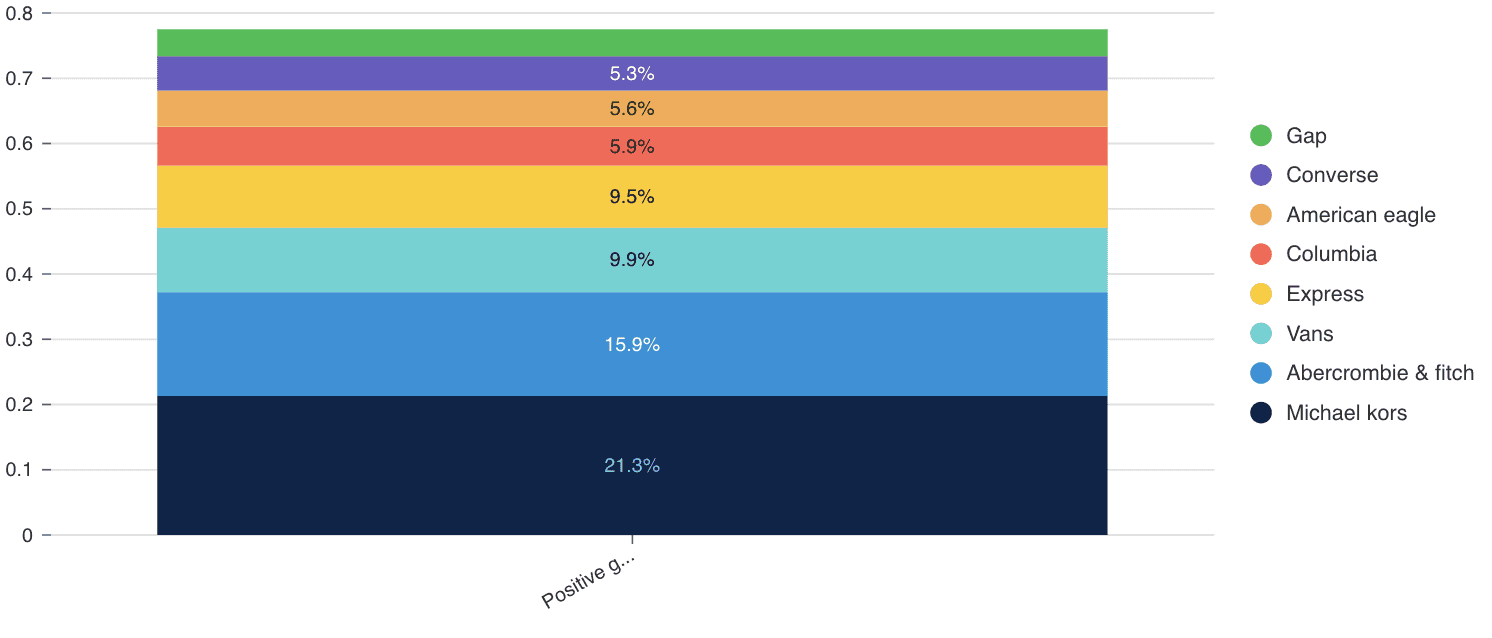
Growth is concentrated in a small set of brands rather than spread across the market. Michael Kors and Abercrombie & Fitch together account for more than one-third of positive brand growth, with Vans, Express, Columbia, and American Eagle adding smaller but meaningful pockets.
For Levi's, this matters because competitors are capturing value-seeking attention even while the total market softens. The brand should treat promotional search visibility as a competitive defense channel, not only a conversion tactic.
Segment contribution to growth
Shows the brands contributing the largest share of positive month-on-month growth in the latest month.
What are the seasonal patterns?
The seasonal pattern looks like a promotion-led summer peak followed by August softness. The three-month window is positive, but the latest month is down, suggesting demand was either pulled forward by earlier sales or fragmented across competing back-to-school offers.
This is consistent with the 2026 retail calendar: back-to-school search interest tends to peak around early August, while shoppers also used June promotional events for school-related purchases. For Levi's, denim and jeans messaging should be live before the August peak, not only during it. (nrf.com)
Where is demand growing fastest?
The available geography view is country-level only, so the strongest read is national affinity rather than state or city opportunity. The United States materially over-indexes for fashion value searches, led by outlet, promo-code, and coupon intent.
For planning, this should be treated as a U.S. market signal rather than a local market prioritization map. The next useful cut would separate college towns, outlet-heavy trade areas, and large denim markets before media allocation.
Which brands are gaining traction locally?
Within the U.S. view, Coach dominates local affinity by a wide margin, followed by Abercrombie & Fitch and Kate Spade. Levi's is visible but not strongly over-indexed, which means the brand's current demand is less locally concentrated than the leading outlet-heavy competitors.
The implication for Levi's is clear: national denim relevance is not automatically translating into value-search prominence. Localized outlet, jeans, and promo-code campaigns can help close that gap.
Who dominates search?
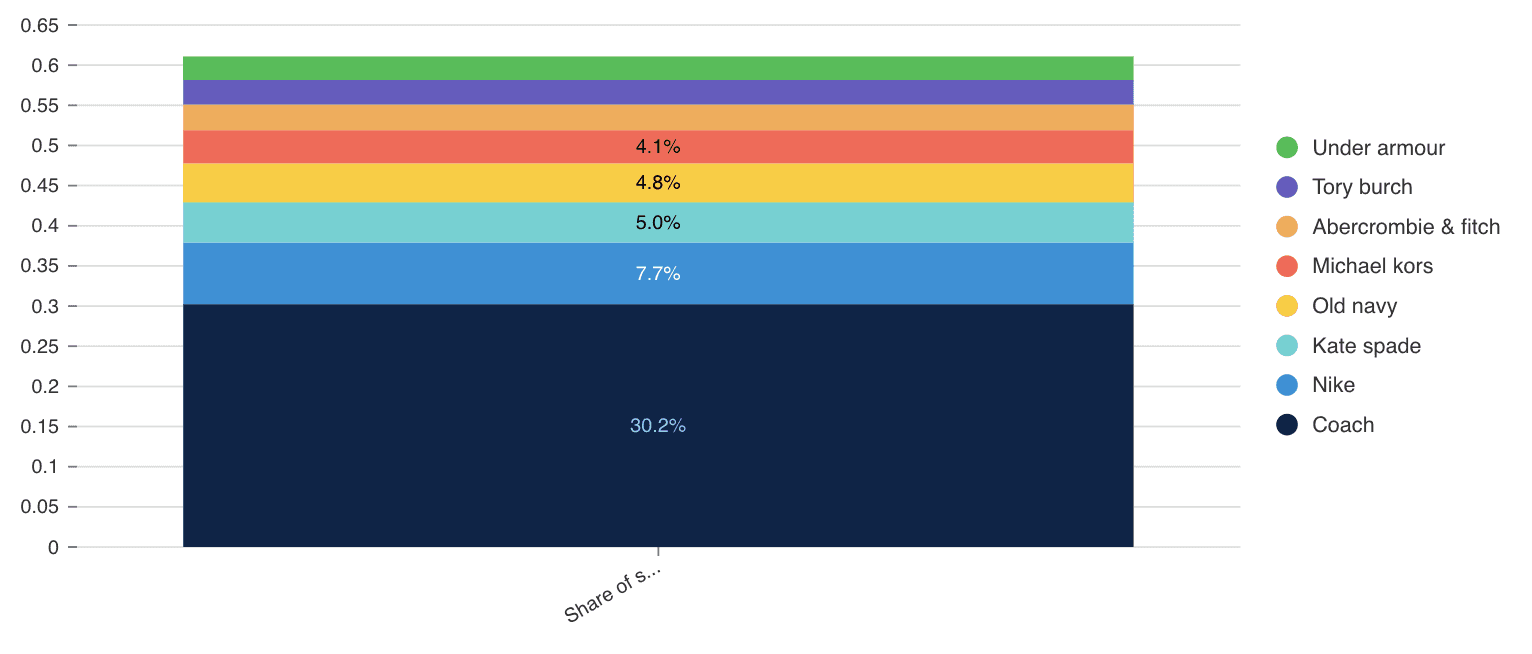
The brand landscape is highly concentrated at the top. Coach holds about 30% share of search, far ahead of Nike and Kate Spade, while the next tier is fragmented across apparel, footwear, and accessories brands.
This creates a visibility challenge for Levi's: the market is not only competitive, it is shaped by a few high-salience outlet destinations that set consumer expectations for value and availability.
Brand share of search
Ranks leading brands by latest-month share of search volume.
Which brands are growing fastest?
The fastest-growing brands are not the largest overall. Timberland, Columbia, Aeropostale, Vans, and Converse show the strongest latest-month momentum among brands with meaningful volume, while several larger footwear and activewear names declined.
This suggests value demand is rotating toward specific use cases and seasonal needs rather than lifting all brands equally. Back-to-school apparel and footwear deal activity likely reinforced this rotation. (aarp.org)
Brand growth vs. size
Shows the fastest-growing brands with meaningful latest-month volume.

How does the focus brand perform?
Levi's is a challenger in value search, not a category leader. It captures under 1% share of search in the latest month, but rolling annual demand is still positive, indicating the brand retains durable relevance even after a weak August.
The weakness is timing and visibility: Levi's fell sharply month on month while jeans-related searches such as old navy jeans sale accelerated. The brand should reinforce value-led denim entry points while protecting premium brand cues, especially as Levi Strauss continues to emphasize a DTC-first denim lifestyle strategy. (sec.gov)
Are searches brand-driven or generic?
Search demand is almost entirely brand-led in this view. Consumers are not just looking for generic fashion deals; they are pairing value language with specific brand names.
That is strategically important for Levi's. Winning depends less on broad category keywords and more on owning branded denim value combinations such as outlet, promo code, jeans sale, and clearance without training shoppers to wait only for discounts.
What topics are associated with the category?
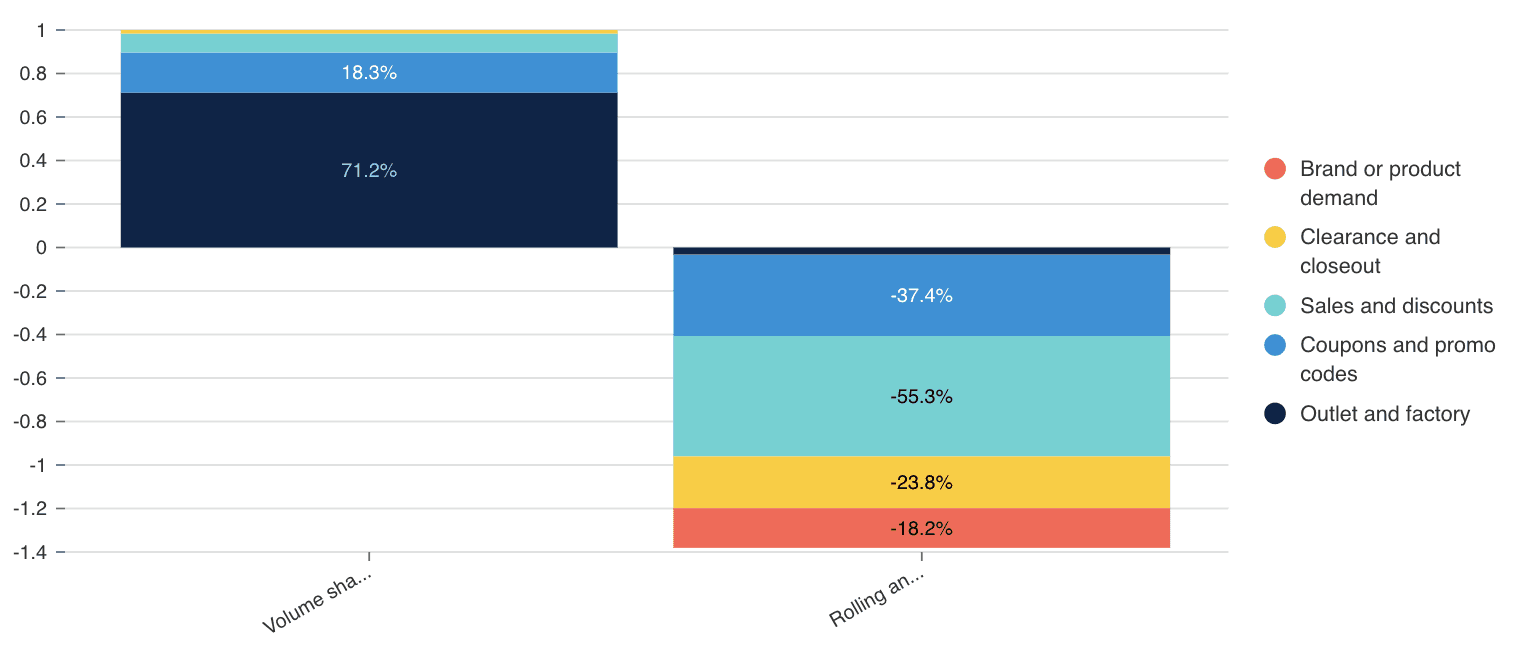
The dominant topic is outlet and factory access, which accounts for more than seven in ten searches. Promo codes and coupons form the second-largest need state, while general sale and clearance language is much smaller and declining faster.
This shows consumers are seeking perceived everyday value and brand access, not only temporary markdowns. Broader consumer research also points to discounts and promotions as major purchase triggers in 2026. (optimove.com)
Top topics by volume and growth
Compares the main consumer intent topics by latest-month share and rolling annual growth.
Are consumers comparing products?
Explicit comparison language is minimal. Searches are less about choosing between products and more about finding the right brand at the right price.
For Levi's, this means the key battleground is not review content alone. The bigger job is to make value, fit, and availability easy to find when shoppers search for branded denim deals.
Where do consumers intend to buy?
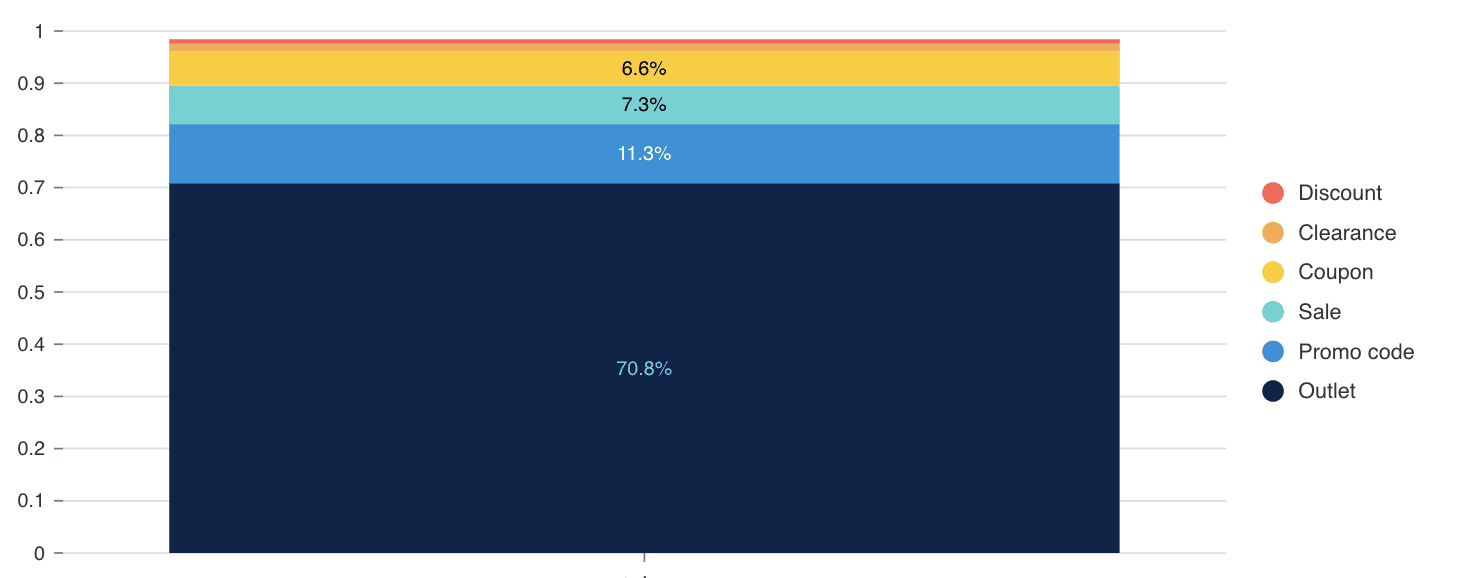
Purchase intent is strongly channel-led: outlet searches represent roughly 71% of pricing-term demand. Promo code, sale, and coupon searches are much smaller, but still important because they sit close to conversion.
This reinforces the role of outlet and factory destinations as a discovery and purchase path for branded fashion. For Levi's, outlet visibility should be managed as a brand experience, not only a discount endpoint. (nrf.com)
Retailer and channel search share
Shows the distribution of channel and value-intent searches across pricing terms.
What drives purchase decisions?
The strongest decision driver is assured value: outlet demand is large and still slightly up, while coupons, sale, clearance, and discount language declined. Shoppers appear more responsive to stable value channels than to generic markdown language.
That creates an opportunity for Levi's to frame outlet and promo messaging around confidence—fit, authenticity, quality, and availability—rather than discount depth alone.
Purchase decision drivers
Shows which purchase drivers carry the most search share and how they changed in the latest month.

What are the fastest-growing trends?
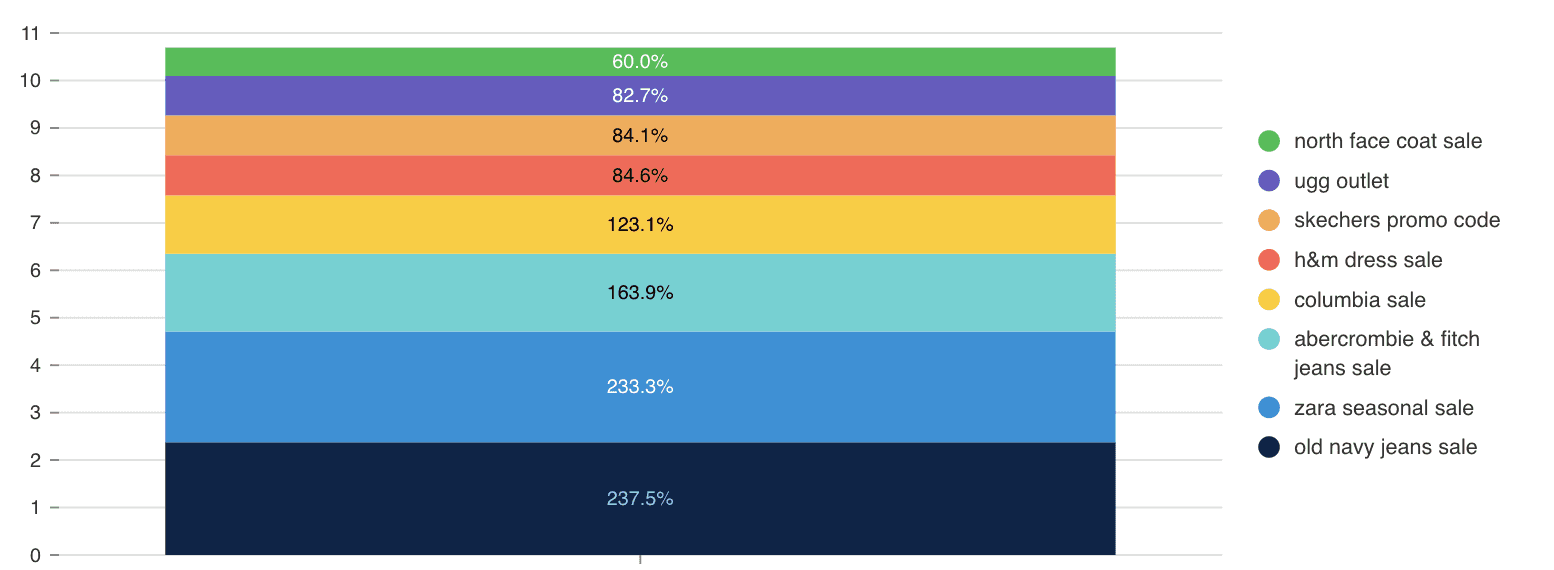
The fastest-rising terms are highly specific and seasonal: old navy jeans sale, zara seasonal sale, and abercrombie & fitch jeans sale lead the latest-month momentum. Jeans and seasonal-sale language are the most relevant signals for Levi's.
The absence of an active TikTok validation signal in this read means the outlook should remain search-led until social momentum is refreshed.
Fastest-growing trends
Shows fast-rising keyword themes with sufficient latest-month volume.
What new needs are emerging?
Three needs are emerging most clearly:
Jeans value: rising jeans-sale searches show shoppers are entering the season with denim replenishment needs.
Seasonal wardrobe reset: seasonal-sale language is growing from a smaller base, tied to the transition from summer to fall.
Promo certainty: promo-code searches remain meaningful even when broader coupon demand softens.
For Levi's, the strongest need to own is affordable denim replenishment with credible fit and quality cues.
What is likely to happen next?
The next phase is likely to be selective rather than broad-based recovery. Outlet demand should remain the most resilient value signal, while generic sale and clearance terms may stay under pressure after late-summer promotions.
For Levi's, momentum is most likely to come from jeans, outlet, and promo-code combinations ahead of fall shopping and early holiday deal discovery. The risk is that competitors with stronger outlet affinity continue to capture the value shopper first.
What are the three most important patterns?
1. Structural growth driver: outlet-led branded value is the center of demand, even as the broader market softens.
2. Consumer behavior shift: shoppers are searching for confidence and access, not just the deepest advertised discount.
3. Competitive dynamic: Coach sets the visibility benchmark, while Levi's has positive annual momentum but weak latest-month capture.
What drives the most variation?
Variation is driven mainly by brand and pricing intent. Coach's share advantage creates strong brand concentration, while outlet searches dominate the purchase journey. Geography adds limited variation in the current view because only a U.S. country-level cut is visible.
Seasonality still matters, but it explains timing more than leadership: the winners are the brands that convert seasonal value demand into branded search visibility.
What should we monitor going forward?
Levi's jeans-sale searches: the clearest signal of whether the brand is capturing denim replenishment demand.
Outlet share versus promo-code share: a read on whether shoppers prefer destination value or deal-stacking.
Coach and Abercrombie & Fitch momentum: competitors setting the pace in value-led branded demand.
Seasonal-sale terms: an early warning for fall and holiday deal sensitivity.
Social validation: refresh TikTok trend signals before converting search momentum into creator or social media investment.
US shoppers are pulling back on value fashion searches—but big brands still draw attention. Search demand fell 11% month over month in August 2026, with outlet searches accounting for 71% of the market and Coach leading the pack. Levi’s faces a tougher climb: despite year-over-year growth, a sharp monthly decline puts it under pressure as rivals such as Abercrombie set the pace in denim-sale searches.
Search Demand Falls as Outlet Shopping Dominates
The market is value-led but currently cooling. August 2026 demand reached about 7.7M searches, down 11% versus the previous month and down roughly 20% on a rolling annual basis. For Levi's, the near-term opportunity is not broad category expansion; it is sharper visibility in the value moments that still hold attention.
Outlet intent is the anchor. Outlet and factory searches represent over seven in ten searches and are the only major intent cluster still slightly up month on month. This aligns with a retail environment where outlets continue to play a clear value-access role for branded fashion shoppers. (nrf.com)
Levi's has a mixed signal. The brand is up on a rolling annual basis, but the latest month fell sharply, suggesting demand was pulled forward or lost visibility in August's promotional noise. The priority is to defend denim value searches while reinforcing the brand's broader DTC-led denim lifestyle positioning. (sec.gov)
Is the category growing or declining?
The category is declining overall, with a short-term rebound failing to offset a weaker annual base. August 2026 search volume fell by about 11% versus July, while rolling annual demand remains down around 20%.
The read is nuanced: the latest three-month window is slightly positive, but six- and twelve-month comparisons remain negative. That points to promotional spikes rather than sustained category expansion. Back-to-school shopping can create early-August search peaks, but 2026 shoppers also pulled some demand into major June sales events. (nrf.com)
Which segments are driving growth?
Growth is concentrated in a small set of brands rather than spread across the market. Michael Kors and Abercrombie & Fitch together account for more than one-third of positive brand growth, with Vans, Express, Columbia, and American Eagle adding smaller but meaningful pockets.
For Levi's, this matters because competitors are capturing value-seeking attention even while the total market softens. The brand should treat promotional search visibility as a competitive defense channel, not only a conversion tactic.
Segment contribution to growth
Shows the brands contributing the largest share of positive month-on-month growth in the latest month.
What are the seasonal patterns?
The seasonal pattern looks like a promotion-led summer peak followed by August softness. The three-month window is positive, but the latest month is down, suggesting demand was either pulled forward by earlier sales or fragmented across competing back-to-school offers.
This is consistent with the 2026 retail calendar: back-to-school search interest tends to peak around early August, while shoppers also used June promotional events for school-related purchases. For Levi's, denim and jeans messaging should be live before the August peak, not only during it. (nrf.com)
Where is demand growing fastest?
The available geography view is country-level only, so the strongest read is national affinity rather than state or city opportunity. The United States materially over-indexes for fashion value searches, led by outlet, promo-code, and coupon intent.
For planning, this should be treated as a U.S. market signal rather than a local market prioritization map. The next useful cut would separate college towns, outlet-heavy trade areas, and large denim markets before media allocation.
Which brands are gaining traction locally?
Within the U.S. view, Coach dominates local affinity by a wide margin, followed by Abercrombie & Fitch and Kate Spade. Levi's is visible but not strongly over-indexed, which means the brand's current demand is less locally concentrated than the leading outlet-heavy competitors.
The implication for Levi's is clear: national denim relevance is not automatically translating into value-search prominence. Localized outlet, jeans, and promo-code campaigns can help close that gap.
Who dominates search?
The brand landscape is highly concentrated at the top. Coach holds about 30% share of search, far ahead of Nike and Kate Spade, while the next tier is fragmented across apparel, footwear, and accessories brands.
This creates a visibility challenge for Levi's: the market is not only competitive, it is shaped by a few high-salience outlet destinations that set consumer expectations for value and availability.
Brand share of search
Ranks leading brands by latest-month share of search volume.
Which brands are growing fastest?
The fastest-growing brands are not the largest overall. Timberland, Columbia, Aeropostale, Vans, and Converse show the strongest latest-month momentum among brands with meaningful volume, while several larger footwear and activewear names declined.
This suggests value demand is rotating toward specific use cases and seasonal needs rather than lifting all brands equally. Back-to-school apparel and footwear deal activity likely reinforced this rotation. (aarp.org)
Brand growth vs. size
Shows the fastest-growing brands with meaningful latest-month volume.
How does the focus brand perform?
Levi's is a challenger in value search, not a category leader. It captures under 1% share of search in the latest month, but rolling annual demand is still positive, indicating the brand retains durable relevance even after a weak August.
The weakness is timing and visibility: Levi's fell sharply month on month while jeans-related searches such as old navy jeans sale accelerated. The brand should reinforce value-led denim entry points while protecting premium brand cues, especially as Levi Strauss continues to emphasize a DTC-first denim lifestyle strategy. (sec.gov)
Are searches brand-driven or generic?
Search demand is almost entirely brand-led in this view. Consumers are not just looking for generic fashion deals; they are pairing value language with specific brand names.
That is strategically important for Levi's. Winning depends less on broad category keywords and more on owning branded denim value combinations such as outlet, promo code, jeans sale, and clearance without training shoppers to wait only for discounts.
What topics are associated with the category?
The dominant topic is outlet and factory access, which accounts for more than seven in ten searches. Promo codes and coupons form the second-largest need state, while general sale and clearance language is much smaller and declining faster.
This shows consumers are seeking perceived everyday value and brand access, not only temporary markdowns. Broader consumer research also points to discounts and promotions as major purchase triggers in 2026. (optimove.com)
Top topics by volume and growth
Compares the main consumer intent topics by latest-month share and rolling annual growth.
Are consumers comparing products?
Explicit comparison language is minimal. Searches are less about choosing between products and more about finding the right brand at the right price.
For Levi's, this means the key battleground is not review content alone. The bigger job is to make value, fit, and availability easy to find when shoppers search for branded denim deals.
Where do consumers intend to buy?
Purchase intent is strongly channel-led: outlet searches represent roughly 71% of pricing-term demand. Promo code, sale, and coupon searches are much smaller, but still important because they sit close to conversion.
This reinforces the role of outlet and factory destinations as a discovery and purchase path for branded fashion. For Levi's, outlet visibility should be managed as a brand experience, not only a discount endpoint. (nrf.com)
Retailer and channel search share
Shows the distribution of channel and value-intent searches across pricing terms.
What drives purchase decisions?
The strongest decision driver is assured value: outlet demand is large and still slightly up, while coupons, sale, clearance, and discount language declined. Shoppers appear more responsive to stable value channels than to generic markdown language.
That creates an opportunity for Levi's to frame outlet and promo messaging around confidence—fit, authenticity, quality, and availability—rather than discount depth alone.
Purchase decision drivers
Shows which purchase drivers carry the most search share and how they changed in the latest month.
What are the fastest-growing trends?
The fastest-rising terms are highly specific and seasonal: old navy jeans sale, zara seasonal sale, and abercrombie & fitch jeans sale lead the latest-month momentum. Jeans and seasonal-sale language are the most relevant signals for Levi's.
The absence of an active TikTok validation signal in this read means the outlook should remain search-led until social momentum is refreshed.
Fastest-growing trends
Shows fast-rising keyword themes with sufficient latest-month volume.
What new needs are emerging?
Three needs are emerging most clearly:
Jeans value: rising jeans-sale searches show shoppers are entering the season with denim replenishment needs.
Seasonal wardrobe reset: seasonal-sale language is growing from a smaller base, tied to the transition from summer to fall.
Promo certainty: promo-code searches remain meaningful even when broader coupon demand softens.
For Levi's, the strongest need to own is affordable denim replenishment with credible fit and quality cues.
What is likely to happen next?
The next phase is likely to be selective rather than broad-based recovery. Outlet demand should remain the most resilient value signal, while generic sale and clearance terms may stay under pressure after late-summer promotions.
For Levi's, momentum is most likely to come from jeans, outlet, and promo-code combinations ahead of fall shopping and early holiday deal discovery. The risk is that competitors with stronger outlet affinity continue to capture the value shopper first.
What are the three most important patterns?
1. Structural growth driver: outlet-led branded value is the center of demand, even as the broader market softens.
2. Consumer behavior shift: shoppers are searching for confidence and access, not just the deepest advertised discount.
3. Competitive dynamic: Coach sets the visibility benchmark, while Levi's has positive annual momentum but weak latest-month capture.
What drives the most variation?
Variation is driven mainly by brand and pricing intent. Coach's share advantage creates strong brand concentration, while outlet searches dominate the purchase journey. Geography adds limited variation in the current view because only a U.S. country-level cut is visible.
Seasonality still matters, but it explains timing more than leadership: the winners are the brands that convert seasonal value demand into branded search visibility.
What should we monitor going forward?
Levi's jeans-sale searches: the clearest signal of whether the brand is capturing denim replenishment demand.
Outlet share versus promo-code share: a read on whether shoppers prefer destination value or deal-stacking.
Coach and Abercrombie & Fitch momentum: competitors setting the pace in value-led branded demand.
Seasonal-sale terms: an early warning for fall and holiday deal sensitivity.
Social validation: refresh TikTok trend signals before converting search momentum into creator or social media investment.
Milena Ozeki
Senior/Lead Product Manager
Share

